16 April 911. Stavrossa.
3.
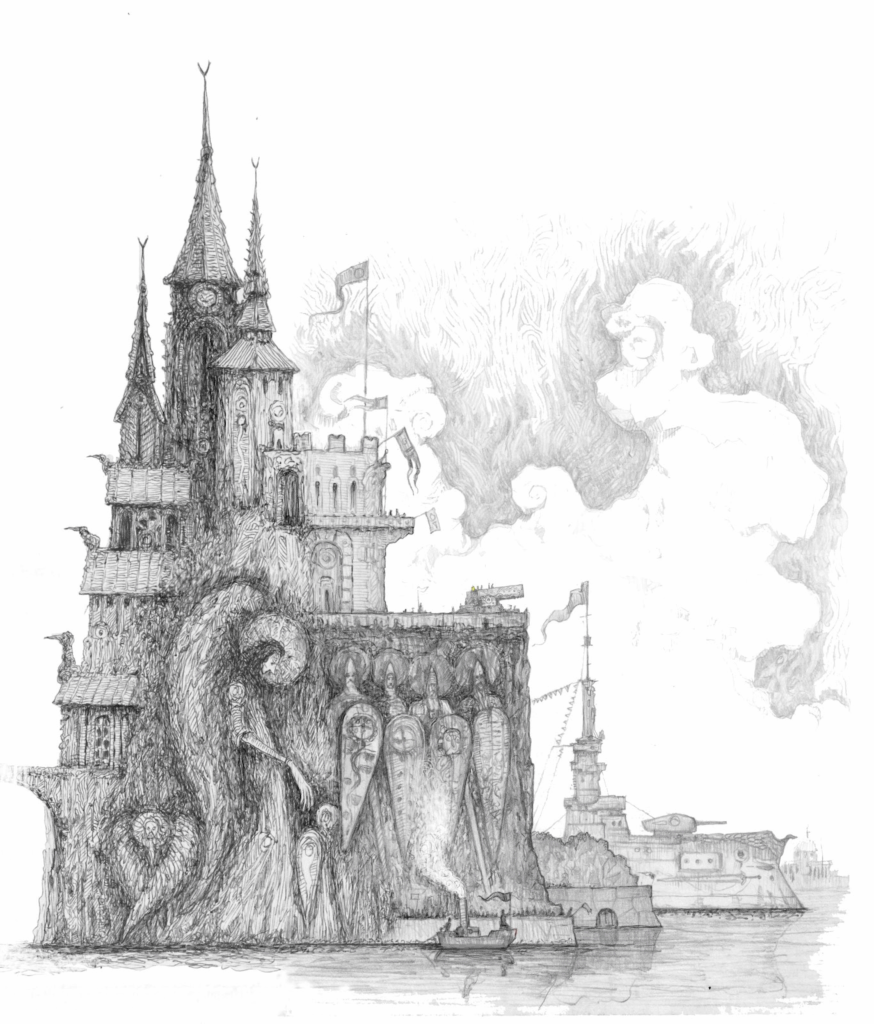
That day, 16 April 911, the Golden Fleet passed beneath the walls of Castle Stavros. Lefty had just turned eleven. His father’s palm, hot as the sun, rested lightly on his shoulder, and he could see that unforgettable sight with his own eyes from the finest vantage point of all: the fortress’s upper wing. Below, the embankment roared with the crowd; brass bands poured marches from their gleaming horns into the fresh sky. One after another the six handsome battleships sailed past, their crews drawn up straight as strings along the decks, their funnels tall as gods, their long-barrelled guns set in steep-browed blue turrets, their many-coloured flags busily snapping in the blue morning wind.
This was the narrowest point of the lower Dunava, less than a peremakh(*) across. Squeezed between sheer cliffs, the blue-black current split against the stone blade of Stavros and burst into the open breadth of the Zemblan Arm. On its left bank, Stavrossa warmed its red tin roofs in the morning sun and glittered with stars on the turquoise cupolas of its temples.
All the high society and authorities of Stavria had gathered to see the Golden Fleet off on its campaign: the tsar, princes and magnates with their families, the heavenly priesthood of the old and new faiths, and the highest dignitaries. Below, on the gun terrace, stood rykar bers in bright, many-coloured coats; Siren brides in black dresses and broad-brimmed white hats with veils; serf nobles in grey and brown tailcoats; senior officers in full dress; eminent citizens in suits and hats; high officials in turquoise Stavrian broadcloth; priests of the new faith in black robes and those of the old in bright scarlet gowns. The giant figures of oratai lords in white Guards uniforms towered above the crowd—all of it afloat in a sea of green and beige dresses, the colours of the 911 season, of parasols and farewell white handkerchiefs undampened by a single tear. For what harm could possibly come to such devastating power?
A week earlier, on the southern maritime frontier of the pantsardom, five enormous warships had emerged straight out of the Dragon Waters(*), looking more like black sarcophagi. Behind them trailed a convoy of dozens of squat transports, equally clumsy in appearance. The armada set course for the Siren Sea. A ship carrying a party of negotiators was sent out to meet the visitors, but its crew were taken prisoner and the ship sunk. Judging by their atrocious manners, these were the accursed Solo, Varvarossa’s old tormentors from the Median War(*).
Twenty years earlier, Varvarossa’s first war against the Solo had taken place—a war no one liked to remember. The proud empire, which considered itself invincible and had long known no great defeats, was beaten at sea and lost the flourishing Median archipelago: its exotic delight, its favourite source of coral, pearls, curious fruits, fabulous feathers, spices, fireproof timber, Zo-zoy nectar, and other goods unnecessary to life but greatly desired. Besides, the chain of Median islands running north to south provided the only passage through the Dragon Waters, which divided the globe with a belt of impassable equatorial storms.
Most of the empire’s ocean-going fleet perished in a succession of naval battles. On the islands, many units of the Southern Corps disappeared or were taken prisoner. The Solo were outnumbered and outgunned, yet through dark enchantments and ferocity they won again and again, sowing doubt among Varvarossa’s troops. Alongside their excellent discipline, the enemy were distinguished by a particular cruelty. Even veterans of the Expanse Wars were astonished by the inventive savagery with which the Solo tortured prisoners and abused the dead.


Bitterly, Varvarossa was forced to abandon the Medians and withdraw to its own northern lands. It decorated its heroes, composed sad songs about the cruel defeat, and laid down a new southern squadron in its shipyards: six battleships of a new type. At the same time, a new Median Corps began to take shape, its soldiers and elder-officers being trained for island warfare. The expedition of vengeance was to wipe away the humiliating defeat, restore the Medians to Varvarossa, and mend its wounded grandeur.
Meanwhile, the southern half of the earth had shut itself off from the north. The devil alone knew what was happening down there, or what the Solo had in mind. Only rumours travelled across the Great Expanse. People said the southern nations were flourishing under Solo rule. Certain smuggled technological marvels seemed to bear this out: radio receivers with everlasting batteries, for instance, or electronic watches with coloured screens. The black market also offered fashion magazines full of exceedingly provocative clothes, cigarettes for different moods, thermite revolvers, women’s underwear made of fabrics like elastic flower petals, miraculous medicines prepared from the private parts of exotic animals, and much else besides.
The years passed, and Varvarossa spent the fire of its resentment. The fabulous sums spent and squandered on the new fleet’s construction had already earned it the name Golden. In time, the Southern Corps ceased to be an elite force of marines who spent their days and nights in exercises and drill. Quartered in coastal garrisons, they looked increasingly like tourists, only in handsome uniforms. These young men in light blue shirts, dark blue shorts, and sunglasses could often be seen over coffee in waterfront cafés or over beer in taverns; at night one could hear how splendidly they sang their sea-going marching songs as they wandered in groups through the narrow streets of port towns.
Untroubled years turned the pages of history. Trams rang, factories smoked, herds grazed, fields ripened; poets wrote of trifles, comedies and melodramas revolved across cinema screens, and the capitals of the realms competed in extravagance while secretly imitating the refinements of the Solo, which seeped delicately up from the lower half of the world. Little by little the Golden Fleet was completed. In 909 the last of its six battleships, Young Mon, was launched. Varvarossa could not admire its beautiful new strength enough, and now held naval reviews every few months, between exercises and trials.
Many people, however, were already saying there was no need for any expedition, or any vengeance. Why take the risk? Now, if the Solo came sailing here themselves, then… And here they were.
In those days the Golden Fleet lay on the Dunava off Vasilissa, ready for a review celebrating the hundredth birthday of Pantsar Iluyanka XXIII(*). The enemy were in no hurry, so the review took place on the appointed date, 14 April, and the following day the fleet set out into the Siren Sea to meet its destruction. Varvarossa’s cautious plan was first to discover the enemy’s intentions. The enormous, unprecedented ships were unsettling: they had, after all, crossed the Dragon Waters. No one knew what else they could do, what armaments or armour they carried. Only one thing could be said with certainty: they moved very slowly—which, given their unseaworthy appearance, was hardly surprising.
The brightly dressed crowd milled around the ancient, gigantic dragon-slaying cannon(*). Resembling some extraordinary antediluvian beast, it was the symbol of the old capital, the star of postcards, stamps, and souvenir photographs. Five hundred years earlier it had been mounted on the walls of Stavros to defend the Mouth against sea monsters. But the Dragon Wars then raging had soon ended, and its rifled belly of spellbound steel(*) had never known heroic fire. The people had nicknamed it the Barren Rose(*). Now children perched like little birds on its lofty carriage, twittering as they watched the naval parade. Suddenly Lefty spotted among them a yellow dress of a poisonous canary hue. A yellow dress and a mane of pitch-black, tightly curling hair: little Margarita.
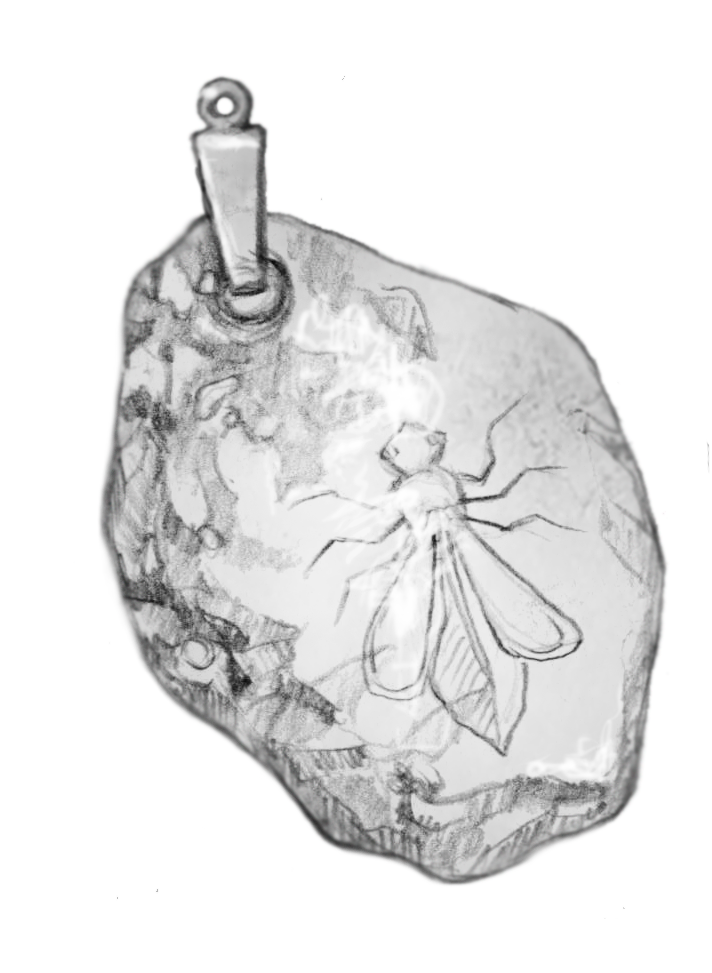
Lefty had met her two days earlier on the Guernica embankment. Quite by chance he had struck up a conversation with this girl who favoured yellow. Afterwards they had walked along the beach. Lefty found a piece of yellow bottle glass rolled smooth by the surf and was about to skim it across the blue waves when he noticed a little bee inside. It turned out not to be glass at all, but amber. The insect suspended within it had bright yellow stripes and large black eyes. ‘She looks like me,’ Rita said, squinting through the amber at the sun. Lefty said they could take the stone to a craftsman, who would drill it carefully and make a fine pendant of it.
That evening they said goodbye outside a small house beneath a flowering lime tree at the end of Underhill Street, and three steps later Lefty had forgotten all about Margarita. He was hurrying home; his mother must have worried herself sick by now. When she was ill, she went out of her mind whenever he disappeared from sight for more than an hour. There was no way to spare her anxiety except to stay with her all the time—best of all, to sit beside her and hold her slender, nervous hand with its protective sorcerous rings. Sometimes that helped. She would slowly get better and become cheerful and noisy again.
Lefty forgot the stone as well: he must have tossed it into his desk or left it in the pocket of his walking trousers. Yes… that was how free he still was then. Now the damned bit of glass was always with him, and more than once he had dreamed bad dreams in which he lost the pendant, or skimmed it away across the blue waves.
Margarita seemed to feel Lefty looking at her. She turned towards the balcony of the upper wing, swept an indifferent, short-sighted glance along the row of Stavrian gentlemen and, failing to recognise Lefty among the turquoise uniform sleeves, turned away. She did not recognise him, and turned away… squinting short-sightedly and winding tight black curls around her finger. And that was when, for no reason at all, Lefty’s heart first gave a twinge of an unfamiliar feeling, like the ache of a tooth in icy water. From that second until his last day, this great feeling would pursue and overtake him like a hungry beast that knew no other prey.
Thus something beginning with L flew to Lefty, fluttered its swift canary wings above him, and he lost interest in the Golden Fleet sailing to its doom.
The following morning, Sunday 17 April, Lefty sat alone in the spacious drawing room of their summer house in Guernica, gnawing an apple and dipping it now and then in sugar. Beyond the great windows, the first hot morning glittered on the sea. Lefty watched the sparkling leapfrog of reflections and thought of Rita, remembering how she had told him that on Sundays her mother took her to the Lavender salon on the waterfront. But so that her daughter would not breathe the fumes of hair dye and nail varnish before her time, she sent her to Jelly Shores, the café next door. There Margarita generally aged for a couple of hours over an ice cream while her mother grew younger in the salon.
After lunch today, Lefty meant to encounter Rita by chance as he passed, accidentally recognise her at a café table, and casually go over. But it was only some time after nine in the morning, and a long eternity still lay before lunch.
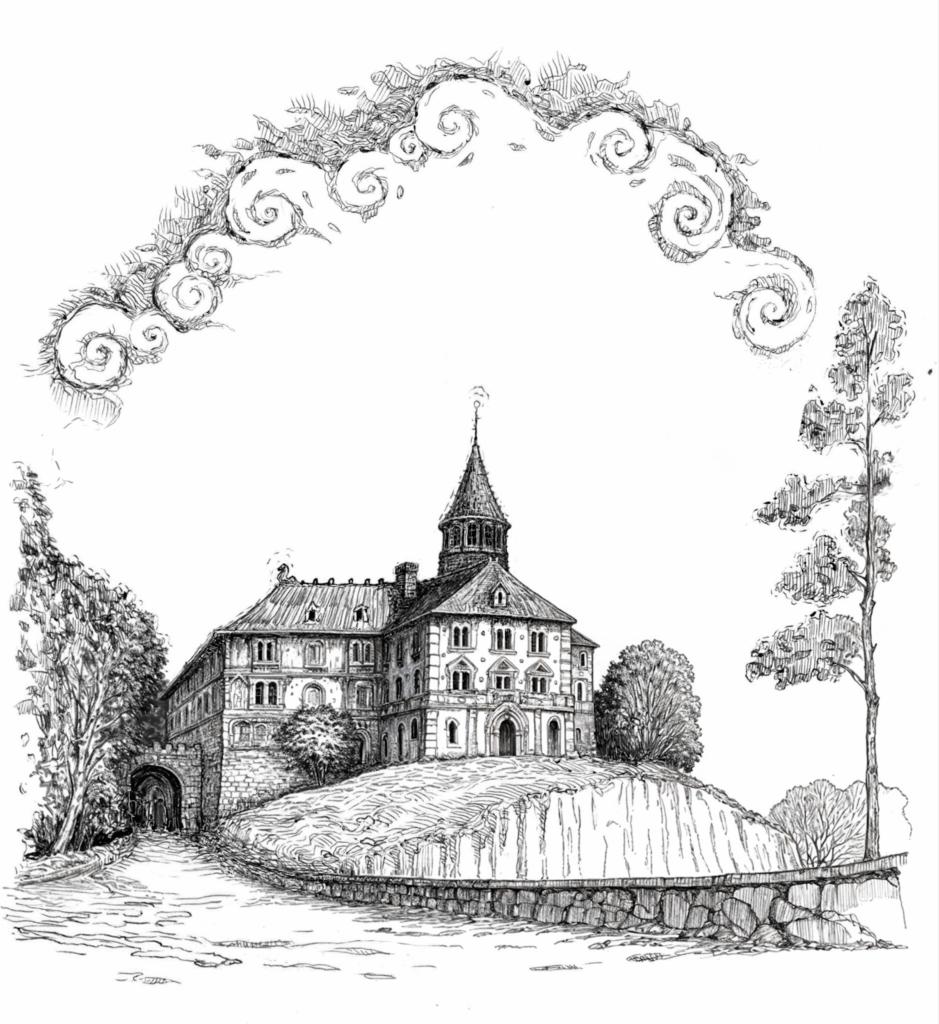
Everyone seemed to have forgotten Lefty. A naval battle against the Solo was expected any day; a throng of officials from the capital had descended on Stavrossa, and his father had been obliged to remain in town. His mother, as usual, had vanished into Yavorov’s clinic—over there below the hill, in the impenetrable grove of royal firs. The clinic stood deep in the thicket, approached by a fairy-tale path. Amid silence, shade, and the scent of conifers, beneath the prickly shawl of fallen needles, hid a building made of old red brick, fine moss, opaque windows, and the secrets behind them. There, in a little room on the first floor, his anxious mother sometimes spent whole days tending her hopeless brother, stranded in a balsamin sleep.
His governess, Panna, was supposed to be looking after Lefty, but somehow she had decided his mother had taken him to the clinic. Otherwise it would have been difficult to explain the moans coming from her little room on the first floor, or the cook’s moustached hooting issuing from the same place. Lefty had already been initiated into what happened between men and women, but he still timidly hoped someone had been playing a trick on him and it was not really quite so disgusting.
At first Lefty thought of leaving a note to say he was cycling to Yavros to see Leya, Yagr, and Lyutovik, but that would not do: Vera would realise he had heard her and the cook. It would be awkward. So Lefty simply got up from the table and ran outside, where the heat was breathing on the garden trees and the sun had already warmed his bicycle seat. A few minutes of chattering spokes and dodging dragonflies later, he clanged to a halt outside the gates of Yavros. Skripka, the local newspaper’s reporter and photographer, came bounding out. He was festooned with cameras and looked, as always, absurdly metropolitan. He waved to Lefty, jumped onto his moped, and sped off with a cheerful buzz. A wisp of blue smoke remained, along with the smell of petrol and Premonition cologne. The reporter used far too much of that fashionable scent.
The old gates stood half open. Long ago they had begun to sink into the ground in this hospitable position, and anyone who cared to took advantage of it. Lefty hopped off his bicycle, abandoned it where it fell, and entered a courtyard that was a strange combination of scrapyard and garden. Lyutovik threw broken or unwanted parts of the Flower Machine out here, while Poleya put things to rights and grew roses, peonies, and irises.
Suddenly Lefty started and stumbled: in the undergrowth beneath the outer wall burned the same yellow that had caught his eye in yesterday’s crowd on the embankment. Of course Margarita could not possibly be here, but in a fraction of a second he had time to feel as though he had stepped on an infantry mine of joy—and then, alas, to see that it was no dress, and no Margarita. Just a pair of yellow flowers swaying among the leaves on stooped stems. A trick of the eye. Disappointment.
Lefty reached the veranda, looking about in bewilderment. The door creaked, and the dry coolness of the house drew him in. The drawing room, always empty and untidy; a dark corridor; two turns papered in green; and at the end a door—the only real door in this house: tall, heavy, with a working lock. A door at which you always had to knock and wait, and which did not always open. This time, though, the lock soon clacked with an oily sound.
Sevastyana Lisovskaya opened it: tall and thin as a heron, with a shaggy cap of bright blue hair. Her long face was painted in ritual azure and ochre. Over her angular shoulders she wore the Sirens’ scarlet satin priestly robe, caught by a gold belt so carelessly and loosely that Lefty’s curious childish gaze could see almost the whole of her small breasts and the lower part of her belly, flat as a runner’s.
With the long-fingered hand holding her cigarette, Yana ruffled Lefty’s hair. ‘Here’s my hero. The terror of the cabbage whites.’ Lefty winced. The previous week there had been an unprecedentedly early invasion of cabbage-white butterflies. They were everywhere, and, with nothing better to do, Lefty had started chasing them with a racquet. That was how they had caught him. Its strings were covered in silvery dust and bright yellow hints of their insides. Yana had given him a scathing lecture about his vile cruelty, and ever since, at every meeting, she had teased him as the exterminator, conqueror, or terror of the unfortunate cabbage whites. Lisovskaya flourished an almost empty bottle of Argon and Bezdez with theatrical grace, let Lefty in, and swayed over to the little sofa in an alcove. There she curled up and covered her head with a cushion.

The tower smelled strongly of hot iron, machine oil, and electricity. The dry, hot air rang softly around the Flower Machine. This vast contraption was a mass of intertwined, twisted steel, glass, copper, rubber, and ceramic. Like a whirlwind, it widened towards the top, growing at its base out of a small black box on a little table in the centre of the hall. One thin wire emerged from the box, forked, and rose into two ceramic cubes. From each cube came two thicker wires, which in turn rose into other, larger and more elaborate devices of metal or ceramic. Still thicker wires crawled out of these; higher up, they braided themselves into powerful cables. Thus, widening and growing more complex, the Flower Machine climbed upwards, coiling round columns, leaning against walls, clinging to the staircase, hanging from cables fastened to the ceiling beams. To Lefty, the Flower Machine had always seemed alive. Now, still hot from its recent work, it creaked, hummed, hissed, whispered, shivered its tangles of tubing, breathed, and stopped just short of complaining in a human voice.
Lyutovik sometimes called the Flower Machine his father. He said old Yavorov had killed himself but never defeated his machine, and that his six-legged thoughts still ran along its wires and pipes, carrying little grains of unrealised ideas in their beaks and hiding them in new places.
Scaffolding encircled the Flower Machine, and Kazimirov was crawling along it at the very top. Wearing a tool belt, work boots, underpants, and gloves, red as a lobster and gleaming with sweat, he turned valves with a spanner, releasing clouds of steam, bridged switches where the wires were sparking, and occasionally turned to shout down at the sleeping Lisovskaya that next time the thing would certainly explode and bury them. Seeing Lefty, Kazimirov gave him a sparing wave, burnt himself on a pipe, swore generously, and returned to his work.
Neither Polina, Yagr, nor Lyutovik was downstairs. Perhaps they were up above? Lefty ran up the stairs and pushed open the door to the panorama room. Silence, no one there, half-darkness; heavy burgundy curtains covered the circular window, and dusty blades of light entered through the few gaps. Here, as everywhere on Yavros, was the familiar alternation of the dirt and chaos wrought by Lyutovik and the order conjured by beautiful Leya, which could never quite catch up. Without her light hands, this room—and indeed the whole house—would have become the most swinish of middens, drowned in cigarette ends, scraps of food, Machine parts, drafts, drawings, and books turned inside out with their minds showing. Lyutovik would never have got lost in a fairy tale: behind him always trailed a track of disorder, small breakages, scratches, and pencils with their ends chewed to fibres. Nor would birds have pecked at what he left behind.

Lefty sat for a while at Lyutovik’s desk. An ashtray—a former coffee mug—crammed with Chevengur cigarette ends stank powerfully, and drafts covered black with writing stirred their pages in the draught. Lefty tried to read something. The sheets, covered in tiny, dense handwriting, were heavy and thick as tattooed skin. He could not even tell which way up they went. How did clever Polina decipher those cramped, unruly ranks of letters, numbers, and incomprehensible signs, like barbarian hordes?
Lefty moved to Poleya’s couch beneath a drip stand with two empty jars, lay there for a while, and fenced with the little toy rapiers of the drip needles. Then he migrated to Yagr’s gigantic armchair. On a table beside it stood an enormous platter bearing the remains of a hero’s breakfast: lamb ribs gnawed to a marble whiteness.
Lefty pulled a book off a shelf, leafed through it until his third yawn, abandoned it, went to the window, and drew the curtain aside. From here he could clearly see the mouth of the Stavrian Arm, and even the Golden Fleet, though very far away. Closer at hand, on the edge of the Children’s Sea’s milky-blue waters, dozens of yachts, boats, and pleasure launches lay plain as a palm. Local sightseers had gone out to look at the beautiful battleships and perhaps catch a distant glimpse of the Solo armada. Today they would have their chance—and from much closer than they would have liked.
A pair of naval binoculars stood on the windowsill. Lefty looked through them, adjusted the eyepieces, and made out the barely distinguishable grey stripe of the enemy fleet on the horizon. Everyone said no battle should be expected in the next few days: the Solo had too few large ships to face Varvarossa’s six battleships. Perhaps they were waiting for reinforcements; or perhaps the Dragon Waters had swallowed a substantial part of their squadron, leaving the would-be conquerors at a loss. Lefty grinned spitefully and shook his childish fist at the grey stripe.
The wall clock, with fish-shaped weights and a mermaid cuckoo that had fallen out of its little window and hung by a spring, showed half past one—as it always did. Just now, though, it seemed to be close to the truth. Perhaps the three of them had gone to the pier for lunch? No, Lyutovik’s car was standing outside. They must be on the beach below the wall.
Lefty left the panorama room, thundered down the stairs, ran along the sloping stone passage to the back entrance, and jumped out onto the hot flagstones of the rear courtyard. He crushed a crumpled Chevengur packet discarded by goodness knew whom, ducked into the hop-choked opening in the wall, and raced down the plunging goat track, ringing with grasshoppers, crumbling into dusty pebbles underfoot, scattering into lizards. Hop! He landed running in the pinkish sand and kicked off his sandals with two flicks.

The secluded beach beneath the cliff enclosed a round bay. At its widest point, Lefty could comfortably swim across underwater, but only Yagr and Polina could reach the bottom. Across the rest of the sea, however, you could run for hundreds of metres in any direction like a saint, ankle-deep and scattering spray. The water seldom came above the knee. Away from the wall, on a low mound amid the sparkling shallows, the half-living Stavrogod Maple writhed in its ancient trunk. In the shade of its only branch still green, Lyutovik slept.
Armed with a stalk of grass, Lefty crept up and tickled his nose. Lyutovik grimaced, sneezed, and, without opening his eyes, warned Lefty that if he dared disturb him once more, he would… Then he fell asleep again. He looked exhausted: a thin, swarthy face, feeble bristles breaking through the skin, and a ripe pimple flourishing on his forehead like a poisonous berry, like the fruit of the knowledge of good and evil. Lyutovik himself resembled a little monkey, with large fleshy ears, thick lips, and a shapeless, blackhead-speckled nose. He had inherited his beauty from his father and perhaps even improved on it slightly. Lefty took pity and left him alone.
A little way off, on the sand at the water’s edge, the giant Yagr sat leaning against a stone, with beautiful Polina asleep on his chest. Lefty went over and sat beside them. The handsome oratai had grown upwards and outwards over the past year. On the drawing-room doorjamb were pencil marks: year, month, name, and height. The uppermost mark bearing Yagr’s name had already reached the wallpaper above the door and announced, in round, boastful handwriting: Yagr, April 911, 226 nail-lengths.
Beautiful Polina, in a black swimming costume and a downy wrap, with her wheat-coloured hair and yellow lashes, slept soundly, embracing Yagr’s mighty arm. As befitted an oratai woman, she was tall and stately—taller than many Stavrian men—but in Yagr’s arms she looked like a schoolgirl. ‘Beautiful’ could not describe her; the word was not enough. With her it was not as it was with other beauties, when everyone agreed that yes, she really was a very beautiful girl. No, it was different: if Polina went out, say, to a confectioner’s or the post office in Guernica, people who saw her slowed, fell quiet, and stood transfixed, as before a miracle.
Usually, meeting a beautiful person is like seeing a woodland bird in a city park, or a rainbow in the sky. But Poleya was like the feet of a triple rainbow rising from the water directly before you, or a golden-maned beast from a fairy tale appearing at the edge of a city park. Her skirt rustled like the wind, her heels clicked brightly on the pavement, and Lefty was terribly proud to walk through town with her, feel her palm upon his shoulder, and be rewarded for making her laugh with all the innocent little kindnesses girls lavish on their favourites. Lefty was spoilt with kisses on his forehead, nose, and cheeks, while his soft childish ears received generous helpings of tender flicks and affectionate tugging.
A couple of metres from Lefty’s bare heels, a dead cockchafer lay on the sand. A wasp flew down and began busily picking at its furry breast. Lefty felt something hard beneath his heart and took the amber with its antediluvian insect from his waistcoat’s inner pocket. He rubbed it with his finger: warm, beautiful. There was a jeweller in Milk Lane, he thought. Surely turning the amber into a pendant would take only a minute. Lefty had a couple of crowns on him: enough, with something left for lemonade or boiled sweets. He began looking at Polina through the golden glass.
It felt strange, looking at his lovely Leya, to find himself remembering in the amber’s slow, caramel gleams an entirely different name and an entirely different face, in which everything was the other way round. Eyes not blue with little green rays, but brown with strong tea leaves in them. Lashes not a fan of wheat, but sharp stakes along the edge of a mocking squint. Poleya’s skin was flawless swan’s velvet; Rita’s, a child’s untidy suntan. Poleya’s hair was fine as sunlit cobweb caught in the lashes; Rita’s was black and tangled as ants’ tunnels.
Even the sounds of their names were opposites: Poleya, Margarita. Poleya—one brief stroke of the tongue against the palate, and the name slipped from the lips by itself. Margarita—that name fought to the last inside his mouth, like living prey. Every time he had to put his tongue through a complicated submission hold to make it sound properly. Every time was a victory for Lefty, with his indistinct r. As the ancient rykars said, a true predator kills with its mouth. Margarita. Margarita.
Heavy, shuffling footsteps sounded in the sand. Lefty turned. Pulev was strolling towards them with a leisurely swagger.
Next episode https://bezdezna.com/en/book/chapter-2-2/