Chapter 1.1
31 December 919. Vasilkov.

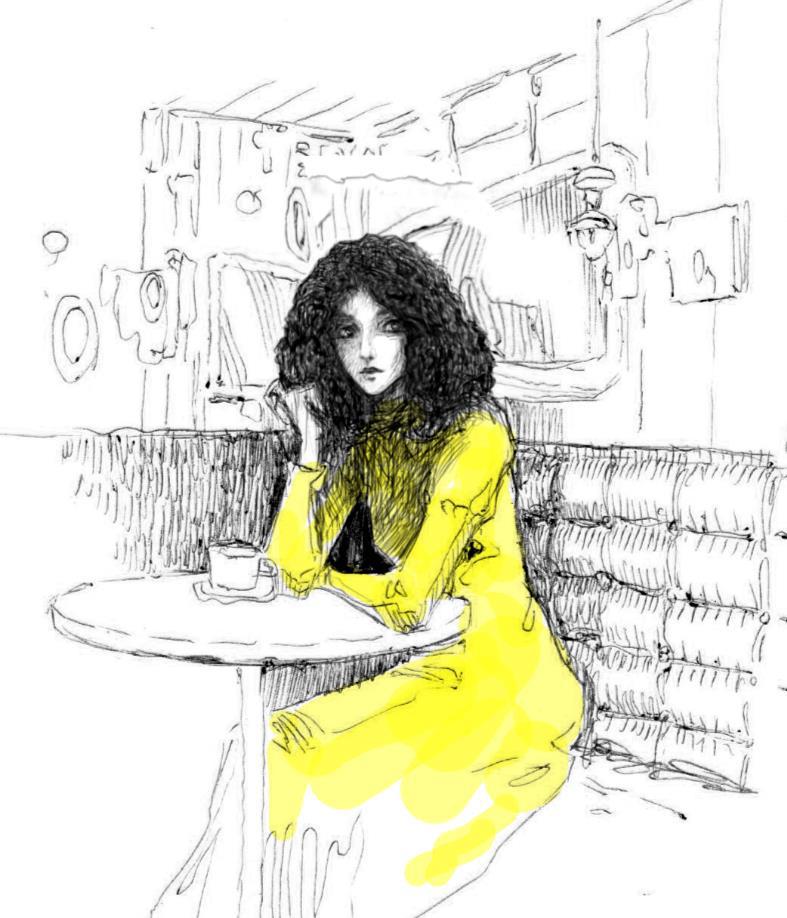
‘See the yellow dress?’ said the caretaker, pointing at the window of Jelly Shores. Margarita sat at the far table in a dress of her favourite colour. Lefty gave a crooked smile. He would have known her from the moon; no need to point. Dropping from his cadaver into the wet snow, he pushed his helmet back and looked at the Children’s Sea vanishing into the darkness of the March night; at the sparse, sleepy lights of his native Guernica; at the café sign, its neon letters blinking cosily through the soft strokes of snow. Well, this was it… All that remained was to go in. A few steps, and… His native Stavrian breeze suddenly whistled through the bare branches and darted inside his collar.
‘Yes, yes… thanks for the reminder,’ Lefty whispered. He drew a pendant from beneath his tunic collar, slipped it off its silver chain, and rubbed it between his fingers: a piece of antediluvian amber. Within the golden resin a little bee lay suspended, wearing a tiny yellow dress with black stripes. Margarita sat with her back to the entrance, stirring a spoon in her coffee cup. Lefty took a small gift box from his greatcoat pocket: glossy white cardboard, diagonal gold stripes, and a straggly, untidy bow on the lid. It was the best he had managed—or rather, had had time—to find. Guernica’s shops were already closing when he swept into town along the Whale-Fish Highway. Lefty put the amber in the box and shook it. It rattled. An innocent gift from childhood in a cheap little case. Almost sweet. And foolish.
‘All right, then. As it is. Here goes.’
Lefty rustled across the shimmering neon snow and took the icy brass handle. Could the entrance to a good place really have a handle so cold it burned? Apparently it could. He pushed the door and stepped inside. The familiar little bells rang out, clear as children’s voices. A sharp profile and quick lashes appeared beyond a black mane of hair. Lefty thought Margarita was about to turn… but she only blew on her coffee, took a red-lipsticked sip, and turned away. Lefty pulled off his helmet, smoothed his hair, fastened the top button of his collar, and slowly approached her. Only a few steps remained. He did not know what he would say, only… Suddenly the air around him rang. The tower clock began to strike; the floorboards trembled beneath his feet. Outside the windows the March night woke, shifted, stars glittering on its black hide, and, snorting fitfully, peered into the little windows with great, anxious eyes.
The clock went on striking in heavy peals. Outside, his cadaver neighed, then suddenly squeaked like a mouse. Had the wicked sisters tricked him, drawn the curtains and put the clocks back so that he would be late? Lefty felt his right cheek grow heavy, the bridge of his nose wrench itself into a ponderous overhang. He clutched his face. It fell apart in his hands and oozed between his fingers. He fought with all his strength to stifle a scream. If only Margarita would not turn now! He fled blindly, seeing everything warped and stretched as though through fire. Gasping from his flight, choking on the greasy air of the outer world, he fell into bed, buried his hideous head in the pillow, and with the clock’s twelfth stroke awoke…
Lefty caught his breath. The walls of his room still hummed after the midnight chimes. Afraid he had lost the pendant, he felt beneath his shirt. Thank God: still there. ‘Useless, poisonous glass,’ he thought bitterly, closing his hand around it. The memories imprisoned in this stone had long since turned bitter, yet he still wore them next to his heart, like a poisoned blade without a sheath. One day he would make up his mind and get rid of it. He would go to the ends of the earth, climb the highest volcano, and throw the venomous stone straight into its throat. The important thing was not to leap after it into the crater boiling with molten amber and bees… Lefty shuddered and woke again.
 The springy ticking of the clockwork tapped out the last minutes of the night. Beyond the window of his room beneath the clock in the tower, the darkness had turned to blueberry milk, full of great flakes of silent snow and the glow of a solitary New Year garland. Somewhere beyond the town came sharp reports. Lefty opened his eyes and listened. Half asleep, he thought it was a salute, but no: rifle shots. A heavy engine roared through the night street; hooves thundered; beyond the town several artillery volleys crashed. From above came the stitching burst of a machine gun, then a rykar’s long signal howl. Then everything fell silent…
His right hand, clasped in its acid bracelet, ached fiercely. The stuffiness bore down on him like a hot body: they had heated the place like a bathhouse. Yesterday at dawn, as Lefty approached Vasilkov along the northern road, smoke had poured from the Crematorium’s chimney more thickly than usual. Vasilkov had been dressed up and silent as a bridegroom in his coffin. These were the days of the winter Turning, but instead of the round-the-clock throng and boisterous New Year carnival in which Lefty had hoped to lose himself, there were only deserted streets, shed tinsel, and the litter of a celebration interrupted.
Lefty had spent three full days in the saddle, with scarcely any sleep amid all his adventures on the roads along the Cursed Field’s edge. He left his cadaver in the Crematorium’s empty inner courtyard, removed its batteries, and carried them and all his acid equipment up the back stairs to his room in the tower beneath the clock. The door had been sealed, the lock forced. Lefty carefully broke the seal, carried in his gear, locked himself inside, propped the coat stand against the door, and pushed a cabinet up for good measure. He put the cadaver’s batteries on charge and, without taking off his greatcoat, lay on the bed for a minute.
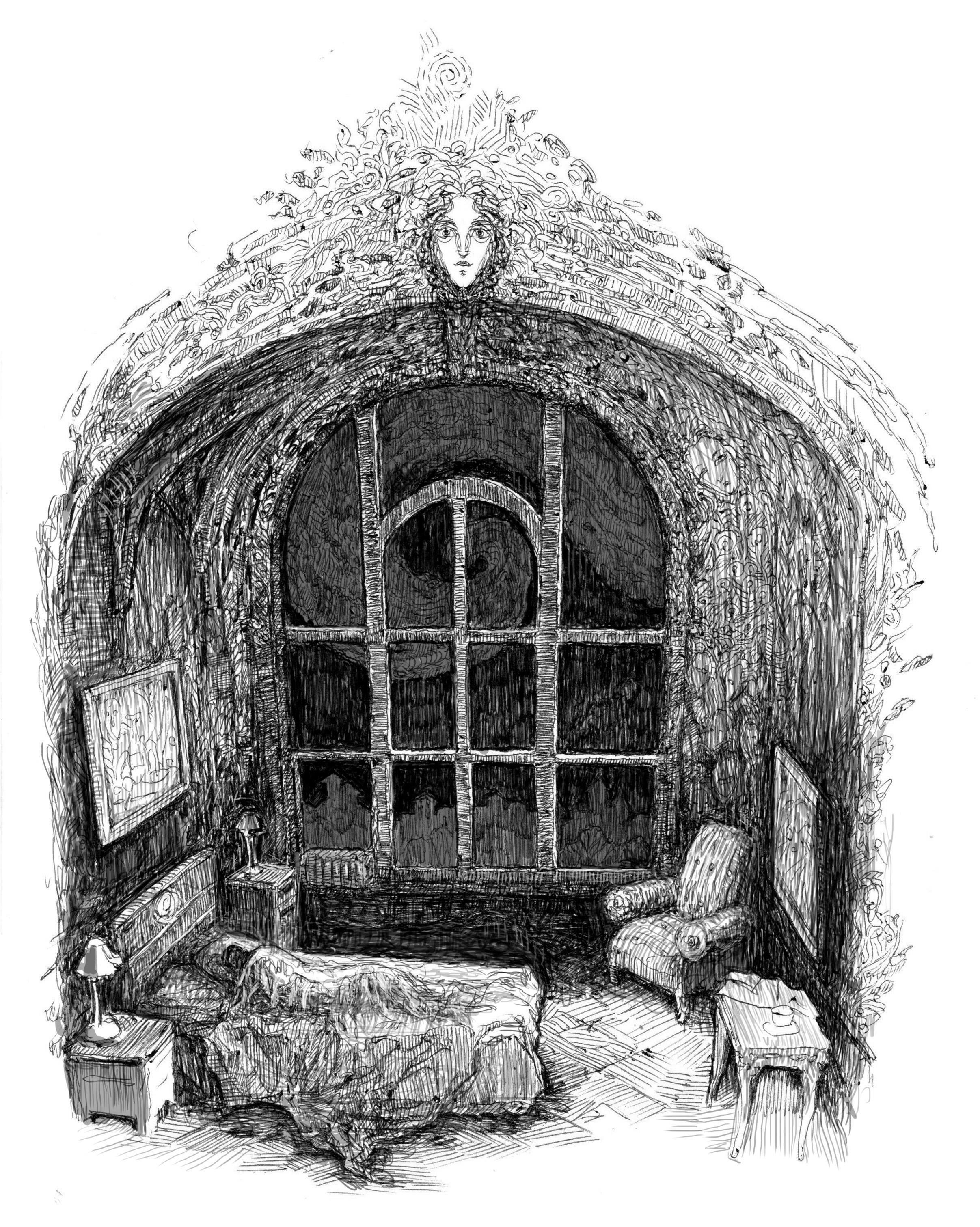
He came to after nightfall. In the darkness overhead a wavering patch emerged: the image of Stavr Swiftwing. The youngest god of the Triad gazed sleepily down at him from the ancient fresco on the vaulted ceiling. On the walls, too, images of sirens and Stavr Swiftwing with his bloodied sword were emerging. Lefty traced the sign across himself, yawned, and rose, limping on his twisted legs. Pressing his heavy, aching hand to his belly, he wandered through the sitting room and tripped in the dark over his travelling bag, with its heap of weapons and acid gear. He felt for the light switch, then caught himself just in time and snatched his hand away. Damn! All he needed was to light up his window in the clock tower for the whole of Vasilkov to see.
He locked himself in the bathroom and listened. Quiet. He flicked the switch. Once his eyes had grown used to the light, he glanced sidelong into the mirror above the basin. One might have thought it warped and bent, but alas, the fault lay with the face the Cursed Field had mangled. Lefty hastily turned from his ugly reflection, took off his greatcoat, heavy with damp and all it had endured, and dropped it on the floor. His trousers and tunic had rotted in the thick, greasy air of the outer world. They peeled off in revolting, disintegrating scraps, which he tossed disgustedly beside the coat. Lefty had stripped this pre-war uniform, soaked with old, clotted blood and pierced by three bullet holes, from a corpse. For the past two months he had wandered the Cursed Field in these rags, like someone else’s dead skin against his naked body.

Lefty sat on the edge of the bath and turned the shower tap. It howled and, jolted from sleep, began furiously humming and spitting first boiling water, then rust. Cursing from the heart, Lefty mastered the damned fool thing. The water came thick and hot; steam shrouded the bath. Whatever else the Crematorium lacked, it had boiling water enough. Another hot shower—and one with such devilish pressure—could not be found anywhere in the surrounding Fieldlands. Lefty took his revolver from his greatcoat pocket, checked the cylinder, and laid it on the little table beside him.
The bath was full. Lefty turned off the water. Silence. His right hand was gripped by a bulky bracelet that looked exceedingly heavy. His thin, milk-white, crooked back, his twisted shoulder blades, his dented head on its slender, skewed neck, his skinny, misshapen legs—his whole body was crippled as though by several different ailments. Still, it was not so bad beside the way he had looked a couple of months ago. In truth, his deformities had one cause, and her name was Margarita. A broken heart was hardly the best companion for a Clockmaker in the Cursed Field. Lefty climbed into the bath, plunged his head under, and entered a muffled, cotton-wool space of unfinished memories: his own, other people’s, mixed together like rice and millet. Faces, voices, shadows fighting at his feet, a yellow dress shed like a snakeskin… No, that was certainly not his memory. Better to surface quickly, before he lost track of which voice in that clamour most needed to breathe the air in his lungs. But Lefty took his time. Teeth clenched, he waited for the strangers to suffocate, leaving only the quietest voice: his own.
Having scrubbed his ugly body pink and squeaky clean, Lefty climbed out, dried himself, and wrapped himself in a bright-red towelling robe. He went into the sitting room and limped around the table. Breathing in the dust of his cosy refuge with pleasure, he felt his way through familiar spaces in the dark. What happiness that his room had not been disturbed, that all his things—the trinkets dear to his heart, books, masks, weapons, acid devices, his first acid suit, and the formal portrait of Sevastyana Lisovskaya as the Star Daughter—were where they had been six months before, when he locked the door and ran away from Vasilkov. Lefty drew the heavy curtains and switched on the bare, unshaded bulb above the table.

Lisovskaya’s blue hair blazed in the electric light. Lefty remembered how she had once turned up at his room decidedly tipsy. It was almost a year ago, towards the end of the New Year revels. Handing him this painting by an unknown artist, Lisovskaya said it was from an admirer for her thirtieth birthday; since Lefty had given her nothing for that cheerless occasion, she was giving him the portrait herself, its paint still wet. She took Polivanov’s crossed swords, a couple of photographs, and a small map of the Cursed Field from the wall above the bed and hung the portrait in their place. ‘This way I’ll keep an eye on you,’ she said, and stayed the night.
After sitting a while in his favourite armchair, thoughtfully picking at its velvet upholstery with a crooked, old woman’s finger, Lefty fetched a cut-throat razor from the bathroom. With it he climbed onto the back of the sofa and, after a little fiddling, removed the ventilation grille high on the wall. In that simple hiding place lay a small metal case.
Lefty sat at the table and opened his travelling case. Inside lay a Spider’s Kiss ritual mask, a ‘hungry’ bowl, a burner, a vial of alcohol, glass flasks, a wad of capital money, a black velvet case, and an assortment of curious instruments that looked half surgical tools, half burglars’ picks. He opened one flask, drank the clear liquid, winced, and sniffed the stopper to chase it down. After sitting motionless for a minute, Lefty straightened as far as his hunched back allowed. Whistling a light tune, he laid the hand with the expedition bracelet on the table. On its reverse was a plate held by a dozen tiny screws. Armed with a small screwdriver, Lefty removed it. Beneath lay transparent tubes through which blood pulsed. The tubes met in a little silvery cylinder that gave off a barely audible ringing.

Undoing the two small screws that held the shutter, Lefty rested his hand on the ‘hungry’ bowl, took a metal probe with a hooked tip, and opened the shutter. Blood gushed out, followed by tiny particles that seemed immensely heavy, ringing as they struck the bottom of the bowl. His hand grew light, as though empty. Lefty hurried to close the shutter, rinsed the cylinder with alcohol from the vial, and screwed the plate back into place.
Finished with the bracelet, Lefty shook his hand in relief, enjoying its newfound lightness. Then he began fishing the largest particles from the bowl, those containing the purest Field dew. He rinsed each with alcohol and dropped it into an empty flask. Eighteen in all. The bracelet’s weight had promised a substantial haul, but he had not expected such rich spoils. Even if he sold the dew in one lot at an ordinary price, the money would keep him comfortably for years in a distant country, in a quiet place beneath a volcano’s shadow.
Now for the most precious spoil. Taking the forceps, Lefty searched on through the thickening blood and at last caught a scarcely visible particle of Field flesh. Brought into the light, it rang musically and filled the air with the incomparable scent of the abyss. Lefty placed it in a little test tube of thin, greenish glass and weighed it in his hand. Weightless to the eye, it lay in his palm as heavy as a lump of lead. He carefully laid the tube in its case, wiped the sweat from his forehead, and laughed. He had turned even his own destruction into spoils. And he would comfort his broken heart. Let it cry no more.
One such particle was worth hundreds of drops of the purest time-dew: an entire life lived, enclosed within a tiny crystal. Now that Lefty had risen from the depths of the Cursed Field, that past life would be forgotten, like a dream by noon. It would melt like a languid cloud, like a many-volume novel in a stove. Soon only beautiful, cooling ash would remain, and within hours even that would be stirred and carried off by the wind of the outer world. But here, in this particle of Field salt, everything was preserved.
The first such particle, brought back last year by Sevastyana Lisovskaya, had cost as much as a seagoing ship fitted out with a reliable crew and a hold sated with treasure. The next particles gathered in the Cursed Field cost many times more. For this last one, some aged tsar would willingly part with his entire tsardom, if only he could live one more life. An entire life in a little, pallid grain. No one else remained alive who could gather more Field salt, and no one else possessed so much as a single particle… Only Lefty.
Well, now it was time to see to himself. Lefty unfastened the fabric in the lid of the case. Beneath it was a mirror, a face traced upon it in fine, precise lines. He took out a black-and-white photograph of a young man whose face was ruled with exactly the same lines as the mirror. He opened the velvet case. Inside was a little silvery machine resembling a thimble, with a winding mechanism and a striker like a tiny pistol’s, except that on the striker’s face a razor-sharp shard of bog iron gleamed black.

Beside the thimble lay a metal rod on a cord. Lefty unscrewed it, loaded a particle from the flask inside, screwed it shut, and shook it vigorously until it grew warm in his hand. ‘We’ll do this quickly. We’ll do this very quickly,’ he whispered, pushing the rod into his mouth and clamping it between his teeth like a bit. His face went utterly white, his eyes sank, his lips darkened. He slipped the thimble onto the ring finger of his right hand and cocked the striker. The clockwork began its nasty, hurrying tick. With a groan of agonised anticipation, Lefty stared into the lined mirror. There was a foul little click.
It was as though an invisible giant had seized Lefty crossways and almost torn him in two. The bit crunched between his teeth. Faster than pain, the dew from the crushed rod pierced his whole body with the electric heat of welding. Every spasm, every great tight knot that bound and twisted his body, burned away in a single second. The mirror cracked and fell into several shards. Lefty gave a long sob. Coarse shudders shook him; the receding pain rang in his head like the finest of strings. He pulled out the bit, spat blood sweet with dew, and lost consciousness.
The clock struck six. The hour of the Beast Neved had begun: the best time of day, when what will happen is still unknown and no impudent plans have yet been made. Beside the case on the table stood a little bowl of barberry sweets, clouded and stuck together. It took some work to break one sweet from the sticky lump: the taste of childhood. Little by little, the outer world was taking its prodigal son into its rough, familiar arms.
Lefty stood, stretched luxuriously, and went to the mirror. In the diffuse morning half-light, a fragile, handsome youth with fine, girlish features gazed out at him. Seen straight on, there was nothing masculine in the face except its sparse, fair stubble. But let Lefty turn a little, and the true adornment of his face revealed itself: a magnificent nose, sharp and straight. When Lefty turned his head, it was as though a three-masted ocean-going ship were laying itself on course.
Lefty opened the wardrobe and took out an unobtrusive beige suit of the sort worn by tourists from the capital who visited the Fieldlands in search of psychic diversions. He chose a tawny hare mask, suitable both for the New Year carnival and for the Fieldlands’ hazardous everyday life. It seemed to say, ‘I’m an ordinary man, with no airs. I don’t want trouble, and I won’t make any.’ Besides, the hare’s long muzzle accommodated Lefty’s nose beautifully.

A clawing scrape came from outside. Lefty went to the window and peered behind the curtain. Below, in the inner courtyard, the caretaker was sweeping. Slow snow wheeled through the air, burying the work of the square, bearded man in his long sheepskin coat. Lefty cautiously opened the window a crack, sniffed the prickly, bitter air, and stared into the pale dawn twilight. This window offered an excellent view of the Cursed Field. But now, with snow falling and daylight only beginning, it was hard to see: merely a dark clouding of space above the Children’s Sea.
On the sill, beside a dried-up cactus resembling a magic doll for spells, stood a sign: ‘Do not look into the Cursed Field. You will go mad and perish.’ In one corner, as a warning, a little man in a straitjacket had been drawn. The artist had skilfully conveyed his mental damage.
Below, the wake-house’s neon sign blinked: ‘The Quiet Pool’. Lefty wanted something to eat, but even more he wanted a drink. As the ancients said, thirst satisfies hunger. Knock back a glass or two of sun-water, drain a large mug of coffee… then his appetite would wake, and he could have a substantial breakfast—an omelette, say, and a local cake under cherry syrup. The outer world briskly struck the lower strings, and Lefty brightened. Besides, he needed a proper look around. The Fieldlands and Vasilkov seemed abandoned. He had to see the Lady of a Face and a Half and ask what had happened here in the months he had been away… By all appearances, nothing good. True, the Quiet Pool’s proprietress usually slept until noon, but perhaps she had not yet gone to bed and was still lapping her clove liqueur over the account books. He could bargain with the Lady over the dew; his chief prize, however, was best kept quiet for now.
In the old days Vasilkov was merry even on the eve of the Turning. The Quiet Pool gave drink to the hungry, the baths washed the drunk, and the Crematorium accepted no dead, bestowing all its warmth upon the living. The Clockmakers were the stars of the celebration, idols surrounded by beautiful sisters. In those days portraits were painted of them as of poets, songs dedicated to them as to heroes, and wagers laid on them as on horses. Children, dogs, and the heroes of illustrated stories were named after them. Luck still followed at their heels as though tame, and descents came easily, like heroic deeds before an admiring crowd. At one point Lisovskaya, Lefty, and their companions had even thought of buying the whole Crematorium, with half of Vasilkov thrown in, so that every Clockmaker, guide, and sister would have a place on the shore of the Cursed Field. It was hard to believe that only a year had passed. A year that had gone through them like a blunt scythe through grass: breaking some, cutting some down, tearing some up by the roots. Was anyone besides Lefty still alive from their close-knit, glorious gang of the Golden Age?

Suddenly Lefty’s heart gave a stab. Only now had he noticed his cadaver below. The enormous horse stood motionless, so buried in snow it was almost invisible. Lefty himself had slept, bathed, and recovered his proper shape, while all that time his faithful horse had stood in the cold with its accumulators removed. Lefty found a coat in the wardrobe and threw it on, pushed his bare feet into the first slippers he found, and unbarricaded the door. He broke the lump of sweets out of the bowl—a treat for the horse—and tucked it into a broad pocket. Taking the two hot, crackling batteries off charge, he lifted them with a grunt and trudged into the corridor, then down the steep stairs. On the table the tawny hare mask remained, ears pricked.
The cadaver greeted Lefty with its customary indifference. It was an old oratai draught horse, pot-bellied, with elephantine legs, a short neck, a mangled donkey-crocodile face, and cloudy, whitish eyes so lifeless that even in winter one imagined flies upon them. Before the war, its Goodwin Series 85 combat rig had been considered advanced. Now the battery cells were corroded, the drives leaked through layers of wrappings and clamps, and the seat had long since lost its upholstery and jutted from its back as a hunched frame. The silver tag on its name strap bore an elegant engraving: ‘Allegro’. It was hard to imagine that this hideous beast had ever deserved so proud a name. Lefty stroked the giant’s blunt muzzle and held the barberry ingot to its mournful black lips. Without a trace of gratitude, the animal crunched its treat.
Suddenly something crashed behind him…
Next episode https://bezdezna.com/en/book/chapter-1-2/