5 May, 911. Whale-Fish.
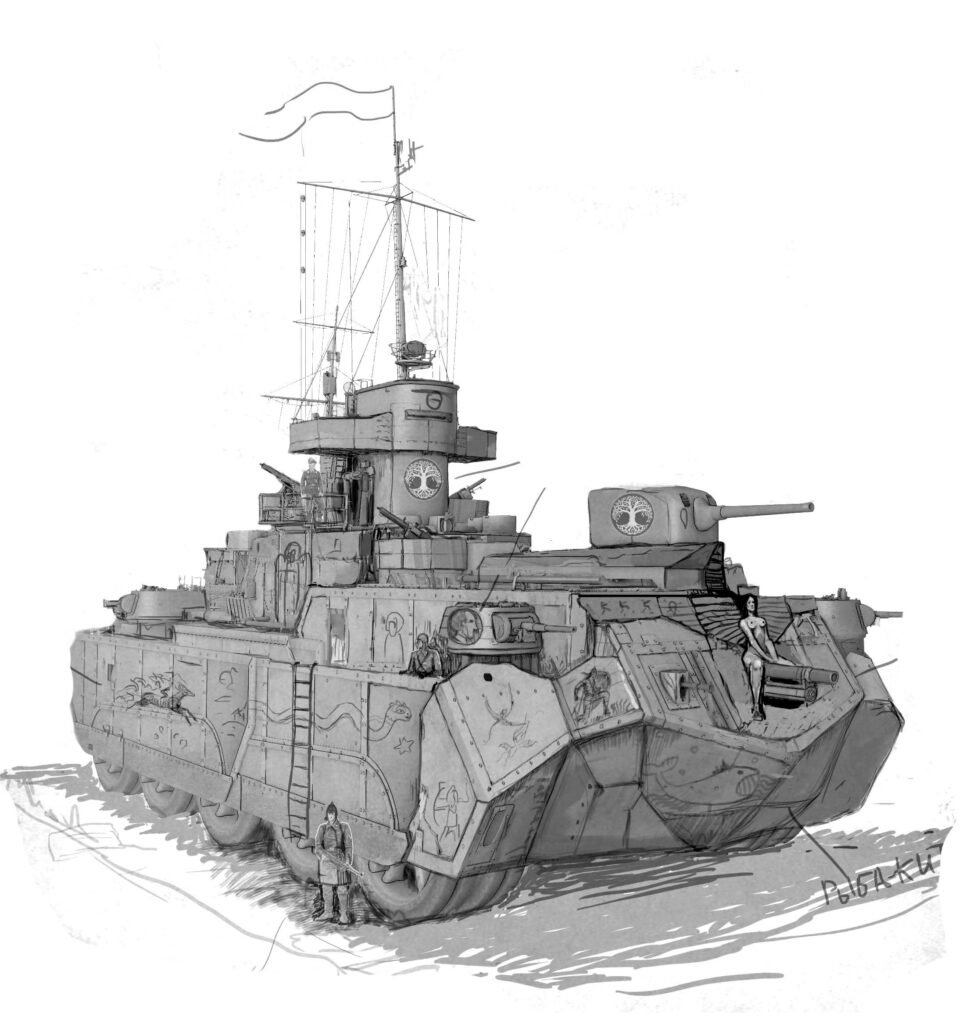
A clear, windless evening settled over the earth warmed by the bright spring sun. Khoron, the ark of the Seventeenth Armoured Spirit Regiment, stood in a sheltered hollow beneath the massive wall of an ancient fortress. No fire from the opposite bank could reach it here. The ark’s main machine-gun mast had been raised high enough for the lookout to see the gentle slope descending to the river and the low northern bank, overgrown with spreading willows and cut by channels. Farther west, in the greenish water of the ford, the burnt-out fighting machines of a shattered Solo assault column were still smoking. That night they had tried to break through here, counting on Khoron to be defending the bridge at Khorovody. They had miscalculated: firing straight from ambush, the ark’s battery had stirred their column into the shallow water like sugar into tea. A relief battalion had arrived a few hours earlier. Its men immediately began preparing their positions, digging trenches, setting up gun emplacements among the ruined ancient walls and pitching platoon tents at the edge of a dark spruce forest. Once their relief had dug in properly, laid mines, strung barbed wire and taken up fighting positions, the Seventeenth could withdraw to rest and replenish its ranks. Tomorrow they were to board barges at Vasilkov’s quay and travel by water to the rear, near Stavrossa.
For now, a quiet evening. Only in the west, beneath a distant black-blue patch of storm sky, thunder rumbled, mingled with cannon fire. High on the lookout mast, Polifemov, the deck battery’s gun-layer, gently rocked a watch-song. His smooth, tired tenor flowed softly over the evening stillness. Sometimes he drew his voice a little taut, like a bowstring, and it rang with shifting overtones; then he released it, and long arrows of high notes flew away and faded in the distance. He was not merely singing but listening with his voice, feeling whether his melody brushed against enemy iron anywhere, whether an enemy boot trod upon his song. When a lookout sang, and when his song was calm as it was now, rykar hearts cooled a little and grew quiet.
Gorvat, a roving commander of the swarm, sat on a fire-equipment chest beneath the gun turret. Stripped to the waist, he groaned hoarsely, grimaced and chewed his young ginger moustache. Behind him loomed the stooped figure of Svit, the ark’s doctor, darning his shoulder with brisk roughness as though it were a kitbag rather than a living man. Svit had been to the Great Expanse many times with his regiment, but in a fortnight of this war he had cut off and sewn up more than in all his campaigns put together. Gorvat alone was under his curved needle for the third time. The man actually enjoyed tumbling off a slain cadaver, burning and roaring his way through thick clouds of bullets and shrapnel. Men like him were gathered into assault flights, and the most reckless was chosen as gallop commander.
First Mate Rigard Negreyev sat on the steps of the captain’s cabin. For a week he had commanded the ark in place of old Captain Dvatov, invalided out, and the crew generally agreed he was doing well. Now Rigard was writing down the names of fallen comrades who had come from Vasilkov. He meant to give the list to the mayor, so that memorial songs for the dead could be commissioned without delay. Rigard was from Vasilkov himself and knew every one of his fellow townsmen. The list held seven names: a great many for a town of barely two thousand. Almost all its inhabitants worked at the Crematorium, or owned or staffed funeral parlours, burial shops and workshops making wreaths, urns and plaques for sacred spruces. Here they would know how to bid their fallen sons a first-class farewell.
A little way off, in the captain’s cabin’s shadow, the regimental lamenter(*) Gella sat wrapped in the black wings of his rykar cloak. He was motionless; only the prayer beads in his long, well-kept fingers clicked out the stanzas of a Basilisk poem. A lamenter has a special rykar gift: with his voice he can cast a delusion over the enemy, slip through patrols like a quiet dream, reconnoitre and bring back a prisoner for questioning. The lamenter sings his song and rolls it ahead of him through forest, across fields, over a river at night, towards the enemy lines. Night, three o’clock perhaps; the moon has hidden behind clouds. An enemy watch stands at the forest edge: four Solo, neither sleeping nor shirking, attentive and composed as always, scarcely human—a mouse could not slip past them. Suddenly thoughtfulness descends over their eyes. Memory runs backwards, as though a song from the past were sounding, and sorrow settles on their hearts. Already one Solo has forgotten his watch, lowered his eyes, begun looking inward, studying the toes of his boots, thinking his private thoughts. Then, in an instant, the boots are right beneath his nose. He cannot breathe, has nothing left to breathe with, and blood pools beneath his cheek. The lamenter has brought his song right up to the post, enchanted the soldiers, taken three heads with his sharp sword and slipped a noose around the fourth man’s neck to lead him away.
It is hard to sing that song. You must carry a great deal of sorrow in your own heart; you must know how not to lose the slender blue thread. Let yourself be distracted and it is as though you wake in the middle of a bad dream: all the lamenter’s invisibility falls away, the enemy’s delusion lifts, and there is little strength left—too little to escape. After such expeditions the lamenter sleeps more and more, at halts, in the saddle, in camp. They do not join attacks, though they are by no means lacking in a battle roar. They must guard themselves against the rykars’ merry fury and preserve a cold sadness in their hearts. On his first campaign into the Great Expanse, the young swarm rykar Gella had felt nauseated in battle, weak and unfit for swarm work. In one skirmish the thoughtful, pretty rykar was badly wounded in the belly. Dying, he saw the Basilisk on a rain cloud, whistling a melody of inexpressible beauty. The orderlies arrived in time and injected him with balsamin.
Gella woke in a hospital in the capital. He had spent two months in a balsamin coma; a third of his intestines and part of his stomach had been removed. The first thing he remembered on waking was the Basilisk’s melody. During his recovery he learned to understand the Basilisk hymns. From them he learned that if you never hurried, combed your long black hair four hundred times with each hand every day, recited three psalms of the circular poem, and thought much about the inevitability of death, the fragility of beauty and women, you would become like the Basilisk and acquire your own strong voice of sorrow.
With their backs to the door of the spirit compartment, the giants Mammoth-Noah and Var-Gurevich sat shoulder to shoulder on an ammunition crate, in full armour, heavy oratai shotguns across their knees. Mammoth-Noah had not even taken off his helmet, merely raised the visor for fresher air. He had already encountered the Solo without armour and had not liked it. He was no rykar, to gallop beneath bullets in a pretty little uniform. Varvarossa had rykars like dogs; he and Var were forged oratai, and the motherland had few of their kind. They had not been trained for war all their lives and fitted with expensive, custom-made armour so that a stray bullet worth one kopeck could end a precious godkin life.
Their assault flight, part of the Fifteenth Reserve Regiment to which he and Var had been assigned, had fought its first battle on 22 April near Busenitsy. A week later there was damn-all left of their company, and only three of the assault flight’s ten oratai remained in action. On 28 April the roads of war, running westwards, brought them together with the remnants of the Seventeenth Whale-Fish Regiment. For two days they held a crossroads together near a village with some equine name. In those battles the ark’s deck-crew sergeant and the defender of its spirit compartment were killed. Without sturdy oratai on deck, an ark was vulnerable at close quarters, and Noah and Var took the fallen men’s places.
A little window opened in the spirit-compartment door. Steam came out, followed by a tired voice, soft as milk:
‘Lads, I’ve cooled the machine. Let me out.’
Mammoth-Noah rose and looked carefully about him.
‘Can we?’ he called to the lookout.
Polifemov too scanned the surroundings, washed them with a searching melody, listened and answered:
‘Let him out. All quiet.’
Mammoth-Noah turned the handles of the armoured door, drew a key on a thick cord from inside his clothing, inserted and turned it in four keyholes in succession, and pulled the door towards him.
In clouds of steam, like a god from the machine, Rainbow, the ark’s spirit keeper, stepped onto the deck. His long white shirt was soaked through and clung tightly to his plump, pink, steam-heated body. His soft dog-fur-lined slippers were brought to him. Rigard draped a white sheepskin coat, golden fleece inward, over his narrow, sloping shoulders. They brought him kvass in a large glass goblet and a silver shot cup of cornflower vodka. His favourite chair was carried out of the engine compartment, and Rainbow was settled in the shade.
After catching his breath in the still, warm air and draining the glass of warm kvass and the icy cup of vodka, Rainbow asked who had been killed in the last battle. Rigard named three men, all mounted riflemen from Gorvat’s swarm. Had a mortar round not caught them at the very start of that morning’s fighting, today would have been their first day without losses. Rainbow lowered his face into his hands and wept bitterly. The spirit keeper is the tender heart of every ark and every spirit regiment. To enable him to sing, his breastbone is split in childhood, a wedge of calf cartilage inserted, and three ribs removed on the left to make more room in his chest. So only thin skin protects a spirit keeper’s tender heart. How could he not weep, when he knew every man by name and face, and these three had died on the last day before they were sent to rest? A spirit keeper is a rykar turned inside out. He does not love death or dream of flying on a burning horse to Father Basilisk. He is gentle; his song is made of verses about spring streams, autumn cobwebs and the evening light in the window of a house made of wings. With songs like these, spirit keepers move hundreds of tonnes of ark and thousands of tonnes of walking fortress.
When he had cried his fill, the spirit keeper wiped his childish face on his sleeve, sniffed through his button nose and gently asked for something to eat. His hot meal had already been brought up from the refuge on a silver tray. Not even the captain ate like that. The regiment’s senior officers dined separately at their own table in the refuge, but ate the same food as the rank and file: cabbage soup, meat, fortified wine and bread. For the spirit keeper, the cook prepared a separate meal from special provisions. Lamb, sturgeon, seafood, cream and berries: all were good for his voice and heart.
A faint, warm breeze carried yellowing petals onto the ark’s upper deck from the wild apple orchard beneath the fortress walls. It swirled them gently and drifted them against a young jack’s red boots. Duke sat beneath the spirit-compartment stairs, watching the lazy motion of the petal snow and dreaming of sleep. He had lost count of the days he had been awake. The last time he had slept his fill, their regiment had still been sailing peacefully down the Dunava towards the Great Expanse. Now was the perfect time to doze: all quiet, no orders from the captain. But his rykar heart, driven to a gallop by war, would give his head no peace.
There were the lyudichi of their regiment: every survivor with no work to do slept like the dead wherever peace had found him. War had worn them out; many were pitiful to look at, as though dusted with ash. But a rykar could not cool so quickly after battle. His blood was still hot, a prickling ringing ran through his whole body. Duke had never even reached the Great Expanse. He was on his first campaign when they were diverted towards Polonna and plunged straight into an unbroken fortnight-long battle the like of which neither the oldest veterans nor even the ancient ark itself had known.
Thoughts chased and tangled with one another; memories were sparks, his skull a brazier of coals not yet cold. His rykar strength had left him without strength. If only he could sleep. But the instant he closed his eyes, a frantic silent film began spinning across his thin eyelids. Roads, roads, heat; people dying everywhere, in the most ordinary and the most unbelievable ways. Dying by roadsides, on town streets, in fields, woods, gullies—everywhere. Soldiers and civilians, women and children, old men and old women, in crowds and alone, accepting death even without witnesses, as though it were something unimportant. Shake your head: conflagrations, fire bursting from windows and chimneys. Squeeze your eyes shut: the wounded screaming. Breathe in: bullets just above your head. Breathe out: caterpillar tracks trembling beneath your feet. Turn onto your left side: the roving commander orders you to race to the left flank with a message. Roll onto your right: an attack from the right flank, and the captain sends you with a packet to the roving commander. Lie on your back, and it feels as though you are dead already.
Sleep had accumulated in Duke’s head and was escaping as falsehood. There went the swarm rykar Truvor, sitting down beneath the mast, winking at Duke, lighting his pipe and blowing smoke rings, as though he had not been killed by a mine three days ago before Duke’s very eyes. There was Bayev, the chief of staff, approaching First Mate Rigard, pushing his helmet back and helping him with the letter, reminding him which other Vasilkov lads had left the regiment on a burning horse. He dictated his own name too: Ivan Demyanovich Bayev, born 875. Killed on 30 April defending Bear Fords. Heroically…
Tormented by this half-sleep, Duke took out his blued revolver and began turning it in his hand: bone grip, a front sight shaped like a pegasus. Beautiful. He could not take his eyes off it. Admittedly, the circumstances in which he had acquired the weapon, and a mighty new cadaver along with it, lodged in his memory as a most bitter lump.
Three days earlier, Duke had raced to the front-line station of Zhuravlyovo with a packet for the roving commander from War Leader Pototsky, but the commander was not in that little town on the crest of a gentle hill. At the way out, beside a roadside canteen with a battered sign reading Samovar, he had found only Gorvat. Gorvat was gloomy: of the twenty-four dashing rykars in his swinehound assault flight, only six remained in action. They had already charged their cadavers’ batteries from the taps on the power-line poles. Now they were replacing them in the cadavers’ bellies, climbing into their seats and preparing to move out.
Gorvat rode up to Duke and took the packet containing the order.
‘I’ll deliver it to the colonel myself,’ he said flatly. He muttered something else about boys being sent racing about like grown rykars, when there were hardly any jacks left as it was. It was true: of Duke’s whole squad, he alone remained unharmed. A few boys had been wounded and sent to the rear; the rest were dead. Normally, on their first campaign, jacks were kept as safe as possible and out of battle. First they were allowed to smell war, to see death and mutilation and grow used to them; only on their third campaign were they admitted to fighting flights. But this time everything had gone headlong, and no one had managed to keep watch over the youngsters. Gorvat sent a discharge through his stirrups, ordered, ‘After me!’ and the flight raced north along the Kovel road, towards the familiar booming of the ark’s guns.
For the first time in days, Duke had no orders. He would have followed Gorvat, but his cadaver, Perekat,was wheezing and shuddering, and its belly already stank of burnt rubber cable insulation. No wonder: for the past couple of days Duke had almost constantly been racing somewhere, without a single chance to eat properly, sleep or tend his fighting mount. And while Duke himself now felt more immortal than tired, the cadaver might drop dead beneath him at any moment. Well, it was time to charge Perekat’s batteries and give it salt water, if it was not too late; it was gasping dreadfully. Duke jumped to the ground, stretched and looked about.
The sun was already hot. A little after nine, Zhuravlyovo station: a row of single-storey houses with blue roofs and apple trees past their blossom in the gardens, alongside a single-track railway ending in buffers at the foot of the hill. Above stood a small church with blue cupolas and a gilded sun on the bell-tower spire, several two-storey stone houses, poplars lining the road, drifting fluff. A little aside on higher ground was a modest ber’s estate with an avenue of young birches. On the waste ground behind the canteen, beside the railway’s dead end, stood several lorries and an old bus, surrounded by fifty or so people: women, old folk, children. They were loading their belongings and preparing to leave, helped by a few soldiers and a young officer of the elder nobility.
In the shade behind the canteen’s summer veranda lay a stretcher. On it a wounded rykar waited to be loaded; his blue uniform suggested the Polonna regiment. Nearby his mighty white cadaver walked in circles. A grey open-topped Bufalon stood by the roadside. Sitting on its bonnet was a tall, imposing man of about fifty with a powerful, beetle-like back, a shimmering blue-green frock coat and a cap with a white band, the kind worn by the bers of Polonna. His considerably younger wife stood beside him with their son, a boy of about five. The ber kept checking his watch and overseeing the loading. Now and then people approached with questions and he nodded or refused. In short, it was immediately obvious who was in charge.
The ber noticed the rykar boy and his cadaver and beckoned him over. Duke approached, leading the gasping Perekat by the bridle. The ber looked at the cadaver with pity.
‘You’ve ridden that black one into the ground. He won’t get his breath back now.’
A maple decoration with a drop of blood gleamed on the ber’s chest, one awarded only for exceptional bravery on the Great Expanse. His face was smooth and coppery; luxuriant yellow moustaches and eyebrows no less impressive made him resemble a large, handsome rose chafer. At the veteran’s side was a holster containing a magnificent Model 870 revolver, with mother-of-pearl inlays in the grip and a pegasus-shaped front sight. Duke tried to object: it would be all right, he only needed to charge the batteries and give it salt water. The ber waved him aside and ordered the cadaver’s batteries charged, its contacts tightened and some sweet water given to it at the last. Duke protested again—come now, he could do it himself. But the ber would not listen and ordered someone to feed the boy.
The cadaver was led behind the canteen. A plump, bustling old woman appeared, gently ushered Duke onto the summer veranda, sat him at an oilcloth-covered table and, a minute later, brought him still-warm cabbage soup, three slices of fried sausage with braised cabbage, and tea in a pot-bellied mug. She brushed away a tear.
‘The last scraps are the sweetest. You’re our very last guest.’
The old woman sniffled, tipped a handful of barberry sweets onto the table and ruffled Duke’s hair. He felt embarrassed: fussing over him like a child, as though there were no war. The cannonade had died away, leaving only the quiet sounds of an almost peaceful life and columns of smoke on the horizon: their own people burning villages so the enemy would not have them. And the wounded man behind the veranda kept groaning and calling his cadaver. ‘Allegro, come here, old friend!’ he cried weakly whenever it passed. But the white cadaver Allegro paid its master no attention and went on circling like a hand around a clock face.
The ber walked into the middle of the street, followed by an elderly soldier and a young lieutenant. The soldier carried a backpack flamethrower and had a cigarette between his teeth. It was an old model, with large khaki tanks, no longer in service. Duke guessed the toy came from the ber’s own military stores. Many veterans of the Expanse were mad about weapons, and the local one was evidently no exception.
‘You’re sure you know how?’ the ber asked.
‘I’ve experience,’ the old soldier answered.
Probably those very flamethrowers had been in use when he was young.
‘Then off you go, with God. Start with my estate, and set it well alight. I’m not expecting visitors… Then work your way down the street.’
The soldier nodded, spat out his cigarette end and went towards the estate.
Duke had only just finished his sausage and still had tea left when the ber’s ancestral home was already blazing fiercely. The flamethrower man was coming back up the street, washing houses to left and right with orange jets. Behind him Zhuravlyovo burned high. Duke gave a careful, grateful belch, finished his tea and put a barberry sweet in his mouth. Its first act was to stick fast to his teeth. The ber still stood in the middle of the street and seemed to be admiring the fire. Behind him his wife wept quietly, and their little son, watching his mother, sniffled too. The crowd wailed and groaned as their homes caught fire one after another, but the ber’s face seemed to show no regret. Had he grown bored with peaceful life? Duke wondered, studying the handsome pistol in his holster: six shots, a high-powered cartridge, a limited edition, a rarity—the weapon of Chip Krechet, his favourite hero from adventure films about the Northern Tributaries. ‘Like it, do you?’ the ber asked, noticing the boy’s interest. ‘Here, have a look.’ With a little smile he came over and offered Duke the pistol. Duke hurriedly wiped his palms on his tunic, arranged his face into a connoisseur’s grimace, took the pistol and began examining it. The ber stole a sweet from his table and went on gazing thoughtfully at the fire.
The station was catching quickly; already they could feel the heat of the advancing flames. The young officer said something to the ber, who turned towards the people and gave a curt order:
‘Everyone into the vehicles!’
Then he turned to his wife and told her to take their son, get into the car and follow behind the column. He would catch them up in ten minutes in the army lorry. Evidently he had decided to be the last to leave his station. His wife caught at his sleeve, but met a stern gaze beneath the shaggy eyebrows, took her son’s hand and went to the car. Engines started. People took their places in the lorries and bus, and the column moved off. Last went the grey Bufalon, the little boy waving to his father from the back seat. The ber did not see him. The flamethrower man approached.
‘I’ve enough mixture left for a couple of bursts. Shall I fire the canteen? We’ll have to load the wounded man first.’
The soldier pointed to the wounded rykar behind the veranda. Duke had already come down the steps and was about to return the pistol when he noticed movement at the distant forest edge, above the place where the refugee column was climbing the hill. He looked more closely.
Several soldiers emerged from the wood to the left of the road, scarcely able to drag their feet; some had no weapons. The familiar rumble of enemy engines followed, but before the enemy appeared, at least a hundred soldiers poured from the trees, all silently fleeing towards the wood across the road. Soon Solo all-terrain vehicles appeared behind them. Duke counted eight. Without stopping, they began spraying machine-gun fire into the fugitives’ backs. Only a few of those who had run first managed to disappear into the wood beyond the road. Worst of all, the refugee column had not yet crossed the hilltop. The Solo appeared directly in front of it, and it stopped.
Duke heard a cry he could not have described. The ber stood beside him, watching the car with his family swerve onto the verge and almost overturn. His wife jumped out, seized their son’s hand and dragged him at a run towards the wood. The other refugees poured out of the bus, jumped from the lorries and began scattering. The Solo did not shoot at them. Several vehicles cut them off from the trees and surrounded them. Someone shouted in broken Royan, ordering everyone back to the vehicles; a couple of bursts over their heads lent force to the command. The people huddled together and trudged back.
Meanwhile two heavy armoured cars rolled out at the forest edge, breaking trees before them, followed by a skirmish line of Solo riflemen. Small groups of prisoners stumbled ahead of them.
Duke looked at the ber and regretted it. Before his eyes, with the crunch of a barberry sweet, an invisible heel was crushing the handsome bronze beetle. The ber’s proud face was turning into a watery pulp mixed with broken chitin shell.
Suddenly the ber moved, abruptly setting off towards the column. Without knowing what he was doing, Duke caught his arm. The man stopped and laboriously focused his empty eyes on him. Duke had nothing to say. He held out the revolver. The ber weakly pushed his hand aside and trudged on towards the column. When they noticed him, he stretched his open palms to the sky, fingers spread, and shouted that he was surrendering.
Duke quickly realised he did not want to watch this scene to its end. He ran around the canteen to his cadaver and found it lying on its side without a sign of life. The lieutenant and his soldiers had already fled, abandoning the lorry. Only mighty Allegro still walked its lonely circle. Duke turned towards the wounded man. The rykar no longer groaned or moved; a fly danced on his grey lips. Duke approached the dead man, took the tag from his neck and the service book from his breast pocket, covered him with his cloak and ran to Allegro. The new master flew into the seat, sent a discharge through the stirrups and raced north along the Kovel road, where Gorvat and his flight had gone forty minutes earlier.