13 March and the Void
In the first days of November 912, the decisive struggle for Polonna began: the Battle of Bagrobor. Fortune passed from Varvarossa to Solo and back again. The front line twisted like a severed live wire, and from the Through Canal to Stavrossa’s eastern bounds the earth lay under layers of the fallen, soaked with blood down to its stony foundations.
By the fifth month of unending combat, it seemed the battle would go on until the last person in the world was dead; that the fire and iron in the bowels of the earth would run out before either side prevailed.
But at 6:20 on the morning of 13 March, the guns suddenly began to fall silent. Vehicles stopped. Soldiers in trenches and camps and on the march stood still and listened. Everything hushed. Every clock stopped; engines died; all electric lights went out, and every electrical device failed at once. Dawn twilight should have been approaching, but the darkness would not recede. It seemed to grow thicker, more impenetrable. Soldiers on both sides, and the inhabitants of territories near the front and far behind it, felt a profound unease and a longing to go somewhere far away. Those who had both the means and a pretext hastened to use them.
Soon unease gave way to an inexpressible sense of emptiness. It grew, driving everyone into a headlong, disorderly flight from that unending night. Soldiers abandoned weapons and vehicles; orderlies left their wounded; behind the lines, mothers forgot their children. People fled in crowds and alone, civilians and soldiers, officers and privates, Northerners and Solo, never looking back—like wild beasts before a forest fire, like fallen leaves driven by the wind. They fled before terror, and terror alone showed them the way.
They ran even after the night was behind them at last. They ran to utter exhaustion, stopping only when they collapsed. Those who caught their breath and dared look back saw a new phenomenon of nature: night, seemingly enclosed within the body of a deep-sea reptile.
For another whole day the stragglers walked and crawled from the March night into sunlight. The later they emerged, the harder they were to recognise. Their faces and bodies were distorted, and still changing. They seemed warped reflections of themselves. Soon they died. For a long time afterwards their twisted skeletons could be found throughout the Fieldlands. No one dared approach them, even to bury them. Neither beast nor bird touched them; no grass grew around them; even the snow of the outer world would not settle on them.
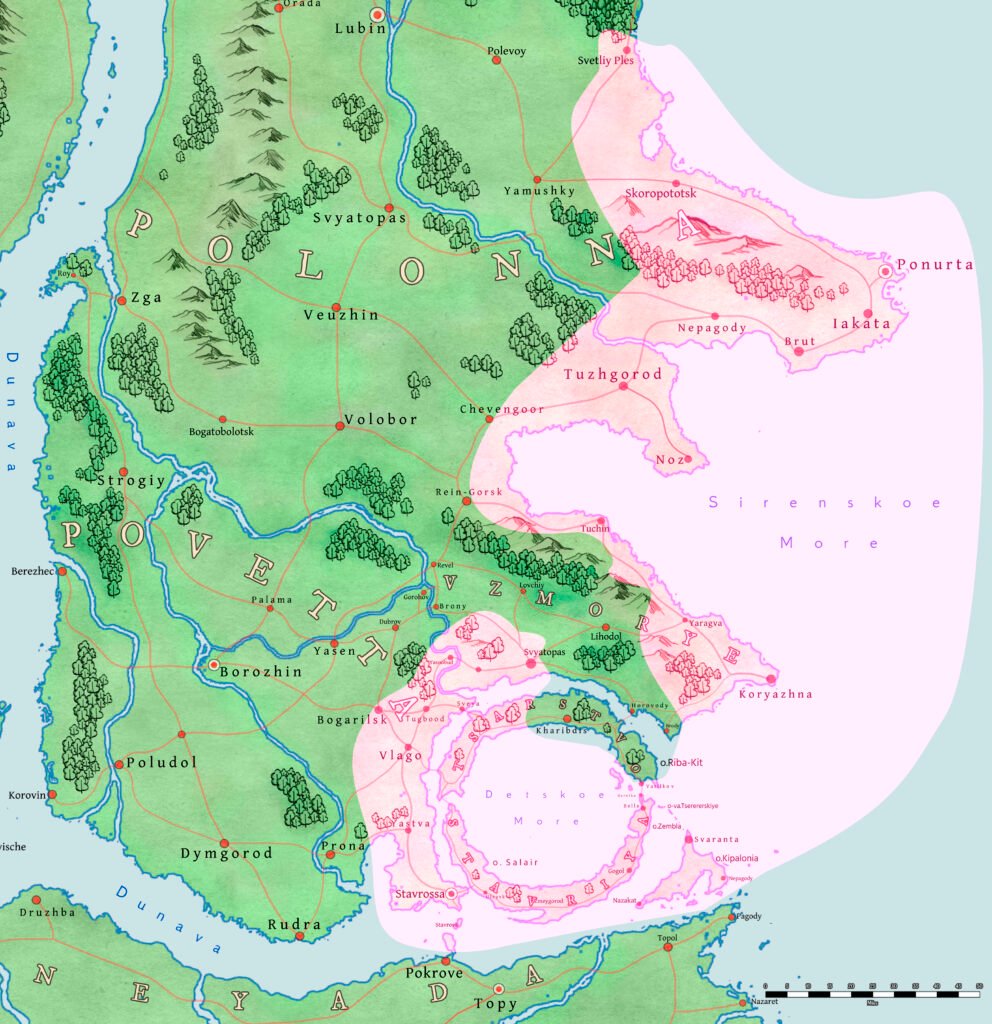
The Cursed Field covered most of the tsardom of Stavria. Within the Field, the March night froze for ever. It is a place of mortal danger: only acid-divers and maravars, protected by rituals and special substances, can enter it. The Field has no clear boundaries and sometimes floods far beyond its usual limits. In the first months after its formation it was especially unstable. On 16 June 912 the first ‘flood’ engulfed the sleeping town of Klyos, forty peremakhs from the edge of the Cursed Field. About three thousand people died that night, and many survivors lost their minds. After this, people began leaving even its distant surroundings. Povetta, Polonna, the Seaboard, and the north of the Dunavan Tsardom were emptied for good.
The Fieldlands
After the Exodus, and especially after the Klyos catastrophe, ordinary people and refugees abandoned even the distant surroundings of the Cursed Field. Thus the Fieldlands came into being: an unpeopled region of deserted towns and villages.
The Fieldlands had two principal divisions, inner and outer. The outer included the towns of Brova, Kopytokopesk, Yastva, Skoropototsk, Chevengur, Lisy, Yezheletsk, and Byor, and the towns of northern Povetta, where the Cursed Field’s boundary ran mostly along the Stavrian Arm.
The Inner Fieldlands encompassed a considerable part of Polonna and Stavria, including Vasilkov, Pobedim, Zga, Alba, Zlatopol, Vezha, Istrin, and Nikomuysk. While the pantsardom’s authorities still exercised some measure of control over the Outer Fieldlands, the Inner Fieldlands, with their narrow entrance at the Nikomuysk Gates, were too dangerous and unstable for lawful order to be maintained. They became the home of the acid folk: wanderers, dealers, brewers, makers of Flower Machines and acid suits, gardeners, guides, mourners, Field preachers of the imminent end of the world, and, of course, maravars and Clockmakers.